Introduction
- Habits are created based on repetition and frequency
- The honest answer to “How long does it take to build a habit?” is: forever because once you’ve stopped doing it, it is no longer a habit
Lesson #1: Defining Identity Based Habits
- When most people think about the habits they want to build, they naturally start by considering the outcomes they want to achieve. The alternative is to build on “identity-based habits” and start by focusing on who we wish to become, not what we want to achieve
- Think about your desired identity and ask, “Who is the type of person that could get the outcome I want?” The focus should always be on becoming that type of person, not getting a particular outcome. Like, If you want to write a book, you should focus on becoming the type of person who writes every day
Lesson #2: The Art of Showing Up
- The Two-Minute Rule [2] which states, “When you start a new habit, it should take less than two minutes to do.” For example, “Walk 10,000 steps each day” becomes “Put on my running shoes.”
- You’re trying to build a “gateway habit” for a larger behavior or bigger ambition that you’re ultimately working toward
- The point is not to do two minutes of work and then never do anything else. The point is to master the art of showing up
[2] Hat tip to David Allen, whose version of the Two-Minute Rule states, “If it takes less than two minutes, then do it now.”
Lesson #3: Choosing a Time and Place for Action
- If you can find the right time and the right place for your new habit, everything falls into place
- One effective way to insert a new habit into your life is with an “implementation intention.” An implementation intention is a plan you make beforehand about when and where to act
- I will [BEHAVIOR] at [TIME] in [LOCATION]
- The more tightly bound your new habit is to a specific time and location, the better the odds are that you will notice when the time comes to act
Lesson #4: Make Habit Formation Easier
- One of the simplest ways to make it even easier to stick with your new habit is to make the cues that trigger and prompt your habits as obvious and as visible as possible
- Unfortunately, the environments where we live and work often make it easy to not do certain actions because there is no obvious cue to trigger the behavior.
It’s easy to not eat fruits and vegetables when they are out of sight in the bottom of the fridge. It’s easy to not do yoga when your yoga mat is hidden away in a box in the basement. When the cues that spark a habit are subtle or hidden, they are easy to ignore.
- Your willpower will not beat your environment
If you want to remember to write in your journal for five minutes at 7am, store the journal on the kitchen table so you see it when you sit down for breakfast every morning.
Lesson #5: Reducing Friction using Technology
- The less friction associated with a habit, the more likely it is to occur. In other words, as convenience increases, so do the odds that you follow through on your habit.
- The ultimate way to reduce friction is to use technology and automation.
- Just as businesses use technology to automate the behavior of the masses, you can use technology to automate your own behavior
Lesson # 6: Priming the Environment
- Environment design, as we discussed in Lesson 4, makes the cues of good habits more obvious. Reducing friction, as discussed in Lesson 5, makes performing habits in the moment easier. Priming the environment adds one more layer: it’s a way to make your future habits easier.
Want to sleep better and develop a wind-down routine? Move your phone charger out of the bedroom and place a white noise machine, your favorite candle, and a couple of books on your nightstand.
- An often overlooked aspect of habit formation: when you’re building one habit, you’re often building multiple habits.
Lesson #7: Motivation
-
In many areas of life, we assume that if we put in a little bit of effort, we’ll get a little bit of results. So, naturally, when we’re trying our best and putting in a lot of effort, we think we should get a lot of results. But habits don’t really work this way. Rather than having some linear relationship with achievement, habits tend to have more of a compound growth curve.
-
Two strategies you can employ to stick with a habit when your motivation begins to fade: temptation bundling and commitment device
-
Temptation bundling works by linking an action you want to do with an action you need do. You’re more likely to find a behavior attractive if you get to do one of your favorite things at the same time. Perhaps you want to watch your favorite TV show, but you really need to fold a basket of laundry.
-
To utilize this strategy for yourself, you can use this formula: I will only [HABIT I WANT TO DO] when I [HABIT I NEED TO DO].”
-
A commitment device is a choice you make in the present that locks in your actions in the future. Example: When you go to the doctor or dentist, always schedule your next appointment before you leave. Now it’s on your calendar. Or, Host a monthly book club or “wine night” with friends so you’re forced to tidy up your home each month.
Lesson #8: Rewarding Habit Formation
-
The vital thing in getting a habit to stick is to feel successful—even if it’s in a small way. The feeling of success is a signal that tells your brain that the habit paid off and that it was worth the effort
-
We learn which behaviors to repeat based on how they make us feel
-
What we’re really talking about here—when we’re discussing immediate rewards—is the ending of a behavior. The ending of any experience is vital because we tend to remember it more than other phases. You want the ending of your habit to be satisfying like watching your favorite TV show after going for a challenging run. You want a reward for a job well done.
-
External rewards are one of the best strategies we have for maintaining motivation while we’re waiting for those long-term outcomes to arrive
-
However, there’s a crucial detail that should not be overlooked. If you’re not careful, the external reward can become the thing you end up chasing (Goodhart’s Law: “When a measure becomes a target, it ceases to be a good measure”.)
-
The key is to not lose sight of your desired identity, and whenever possible, to choose an external reward that reinforces the type of person you wish to be. You want to avoid rewards that conflict with your desired identity
-
Incentives can start a habit. Identity sustains a habit.
Lesson #9: Habit Tracking
-
When it comes to building better habits, a crucial step is to visualize the progress you’re making, and to be able to see yourself move forward
-
The most basic format is to get a calendar and cross off each day you stick with your routine
-
Once you have created your habit tracker, the point to keep in mind is “never break the chain.”
-
No matter how you do it, these strategies provide proof of your progress. One glance at the X’s on the calendar or the marbles in the jar and you immediately know how much work you have (or haven’t) been putting in.
-
These visual signals of progress can be particularly powerful on a bad day.
-
The best strategy is to make an implementation intention for tracking. For example: I record my set in my workout journal after I finish each set at the gym
-
Use a simple rule: “never miss twice.” If I miss one day, I try to get back into it as quickly as possible. Missing one workout happens, but I’m not going to miss two in a row.
-
The breaking of a habit doesn’t matter if the reclaiming of it is fast. The first mistake is never the one that ruins you. It is the spiral of repeated mistakes that follows.
-
Missing once is an accident. Missing twice is the start of a new habit.
-
The key insight of this lesson is to visualize the progress you’re making each day. If you have to wait for the number on the scale to change then the feedback loop is often too long for you to maintain motivation
Lesson #10: Social Environments and Habits
-
The way that social environment influences our habits is through the tribes we belong to and the groups we are a part of.****
-
The key factor in any of these tribes is that we have a sense of belonging. When you want to belong to a tribe, you want to repeat the habits of that tribe. We naturally soak up the habits of those around us.
-
Your culture sets your expectation for what is “normal.” Surround yourself with people who have the habits you want to have yourself. You’ll rise together
-
New habits seem achievable when you see others doing them every day. If you’re surrounded by readers, you’re more likely to consider reading to be a common habit
-
Nothing sustains motivation better than belonging to the tribe. It transforms a personal quest into a shared one
-
The shared identity begins to reinforce your personal identity. This is why remaining part of a group after achieving a goal is crucial to maintaining your habits
Lesson #11: Moving On from Two Minutes Habits
-
When you start out building a new habit, it’s exciting in the beginning because it’s new. When things are new, it’s novel and interesting. Over time, however, habits become routine
-
Once you know what to expect, habits tend to be less interesting. Sometimes they even become boring. This can be one of the first signals that it’s time to graduate your habit to the next level
-
When your old habit becomes boring, you know it’s time to move on. However, this can be a potential pitfall because, once people get bored, they start looking for something new to do. The key is once you get bored, you stick with the same habit, but find a new detail to master or get interested in
-
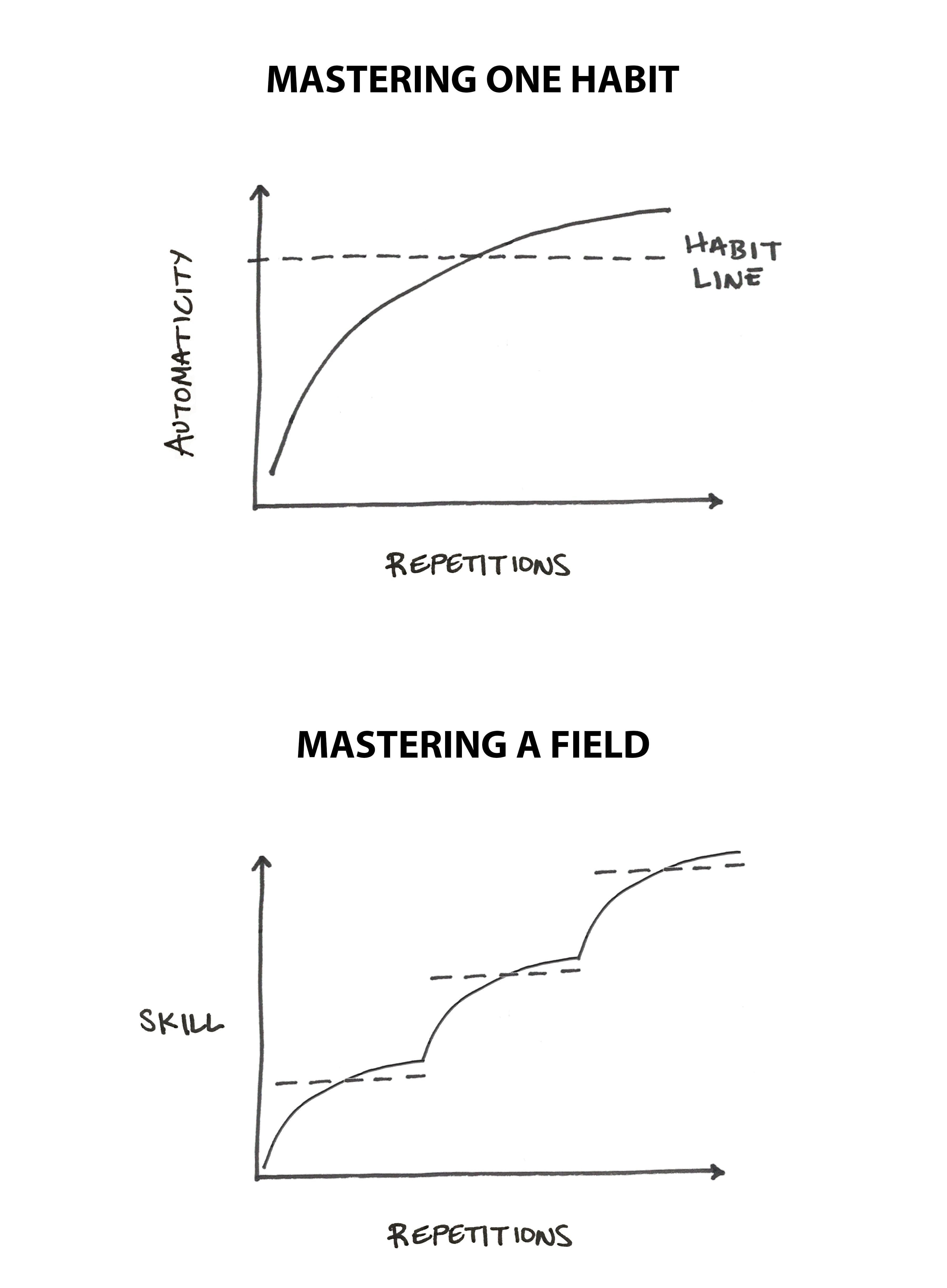
The second thing you can do is to stick with the same habit, but scale up the intensity or volume. In this case, the potential pitfall is jumping from a small version of your habit to something massive
-
Habit graduation will always be a personal choice and require some level of guess work. One of the metrics I like to keep in mind is choosing a new level that is exciting enough that I’m no longer bored, but easy enough that I know I’ll be able to do it 98% of the time
-
The Goldilocks Rule states that humans experience peak levels of motivation when working on tasks of just manageable difficulty. Not too hard, not too easy, just right. This is precisely the region where habits remain motivating and exciting. Working on challenges of just manageable difficulty is a good way to keep things interesting
-
If at any point, you expand your habit to a degree where you are no longer succeeding consistently, you know you have surpassed the goldilocks zone and you should scale back down to something easier